
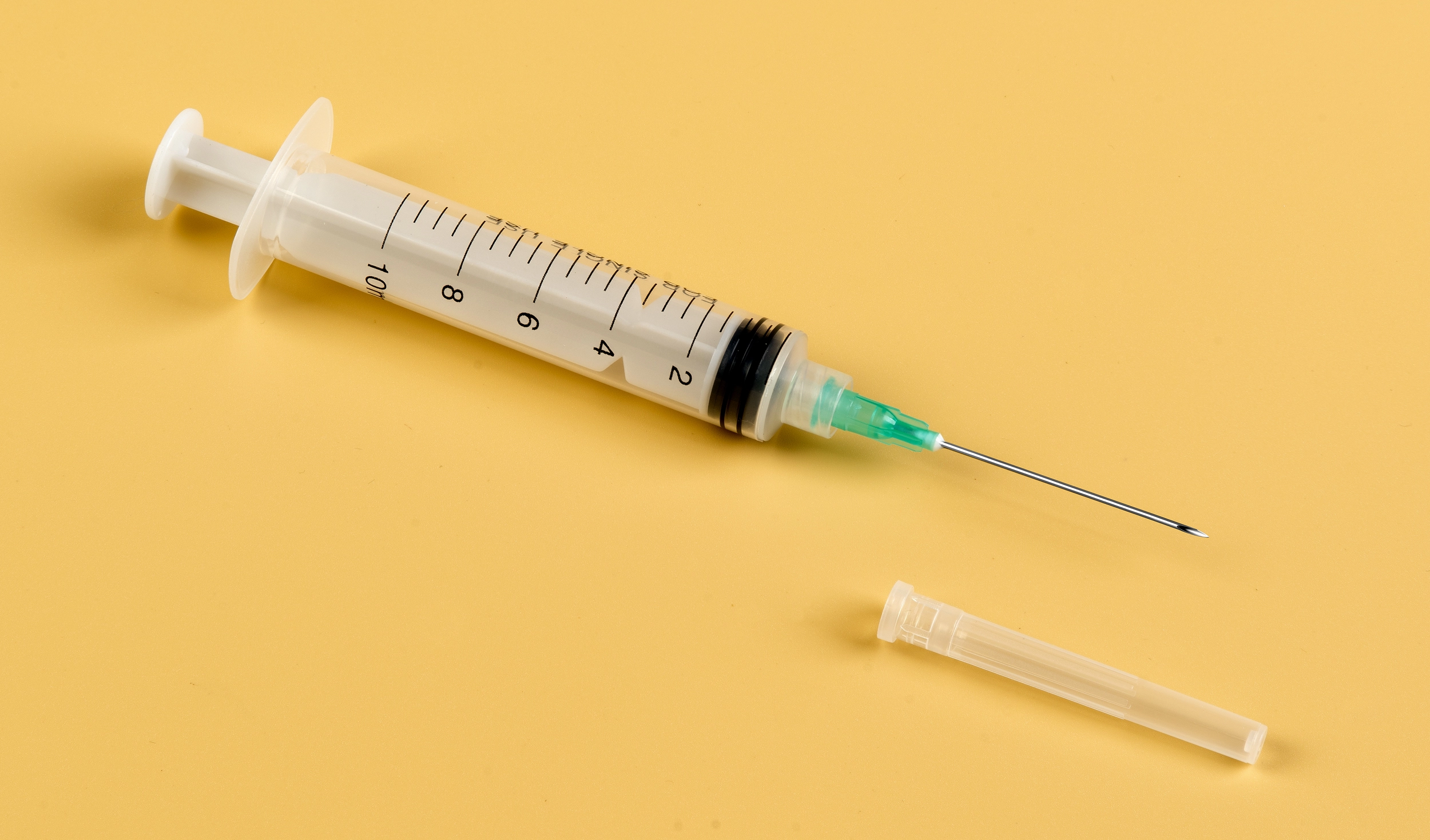
A hypodermic needle looks like a commodity. Stainless tube, a molded hub, a cap. In practice almost nothing about it is interchangeable, and the differences that matter clinically are decided at specification stage, long before a price is agreed. Two needles that quote at the same price can differ in inner diameter by 20 percent, in penetration force by a factor of two, and in whether they will fit the device your customer already owns.
This guide sets out the parameters that define a needle, in the order they should be fixed. It is written for buyers commissioning a custom or private-label needle, and it reflects what we work with daily at Wenzhou Taiyu Medical Technology Co., Ltd., where precision needle components have been manufactured since 2009 across clinical, laboratory, dispensing and raw-material applications.
What a Needle Specification Actually Contains
A complete specification has seven parts: gauge, length, wall thickness, bevel geometry, surface treatment, connector, and hub. Each one is independent of the others, and each one changes something the end user will notice. Most specification problems arise because a buyer fixes the gauge first and treats the rest as detail, when in practice the wall thickness and the bevel often matter more than the gauge number printed on the box.
Gauge, Inner Diameter and Wall Thickness
Gauge is a measure of the outer diameter of the needle tube, and it rises as the tube gets thinner. It does not, on its own, tell you how fast fluid will move through the needle, because flow depends on the inner diameter of the bore. That is why wall thickness has to be specified alongside gauge, not after it.
Why thin-wall tubing changes the flow rate
Our needle tubes use a thin-wall design, which produces a larger inner diameter than a standard-wall tube of the same gauge. The clinical consequence is straightforward: a higher flow rate at the same outer diameter, which matters most where the needle has to deliver a given volume quickly through a fine gauge, as it does in insulin delivery and in pediatric and cosmetic applications. Where a customer asks for a finer needle without accepting a slower flow, the answer is usually thin-wall tubing rather than a specification compromise.
How fine the range goes
Fine-gauge production is limited by grinding capability rather than by the tubing. Our range includes ultra-fine gauges down to 34G, and our cosmetic needle line is offered in 0.25 mm, 0.23 mm, 0.20 mm and 0.18 mm sizes. At these dimensions the outer diameter is no longer the only critical figure: concentricity of the bore and consistency of the wall become the parameters that decide whether the product performs the same way on every unit.
Length and Bevel Geometry
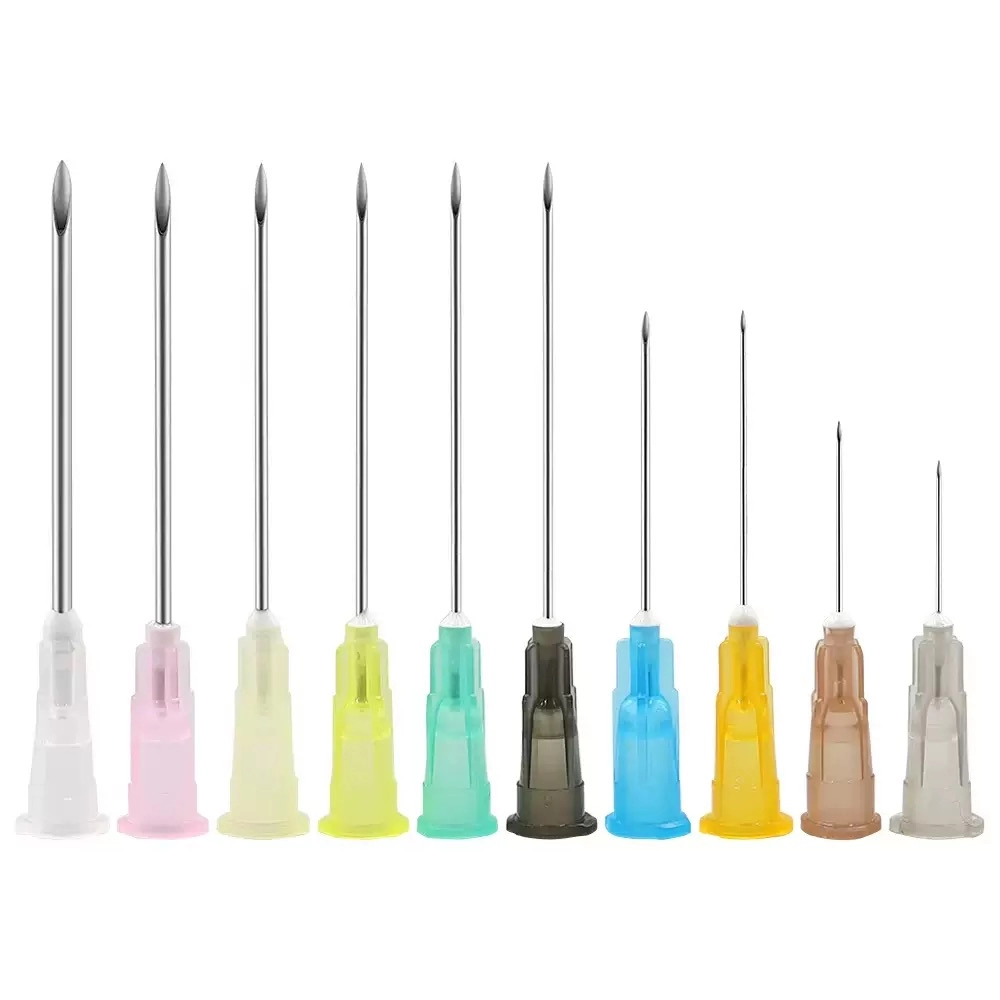
Length is measured from the tip to the junction with the hub, and it is dictated by the injection route the product is intended for. Intradermal, subcutaneous, intramuscular and intravenous use each imply a different length, and the length also has to be consistent with the depth of tissue below the skin, which varies by patient group and by body site.
Bevel geometry is where most of the patient experience is decided. The bevel is the angled grind at the tip, and its angle and the number of facets ground into it determine how much force is needed to enter tissue and how cleanly the tissue closes afterwards.
Triple-bevel grinding and silicone coating
Our needle tips are produced by advanced triple-bevel grinding, with a silicone coating applied to the surface. The purpose of both is to reduce penetration force: a well-formed multiple-facet bevel cuts rather than pushes, and the coating lowers friction as the needle passes through tissue. The result our customers most often comment on is reduced discomfort during injection and less tissue damage at the entry point, which is precisely the combination that separates a competitive needle from a cheap one. The same grinding discipline applies to specialty tips, including the special bevel specified for our cosmetic needles, which is shaped to limit skin damage and to reduce residual liquid left on the surface after treatment.
The Connector: 6:100 Conical Fitting
The connector is the part of the specification that generates the most compatibility complaints, and the least attention at briefing stage. Our needles use a 6:100 conical connector that complies with the relevant international standards, which is what allows a needle to seat reliably on a syringe or a device from a different manufacturer. The tolerance on that taper is what a buyer is really purchasing: an undersized or badly molded cone will either leak, wobble or fail to lock, and none of those faults will show up in a sample that is only inspected by eye.
An injected or molded hub also has to hold the tube itself. Our dispensing syringe hubs use a precisely angled aperture to connect to the needle cannula, which produces a firm bond and prevents fluid leaking at the junction under pressure.
The Hub: Color Coding, Translucency and Safety
The hub carries three functions. It identifies the needle, it connects it, and increasingly it protects the user. Our hubs are color-coded so that gauge can be identified at a glance, and they are molded in a translucent material so that blood backflow can be observed without disconnecting anything, which is a practical requirement in routine clinical use rather than a cosmetic feature.
Safety features belong in the specification from the start, because they change the mold. Our needle assembly can be supplied with a protective shell that shields the used tip after injection, which is designed to reduce the risk of accidental needlestick injury to clinical staff and to limit the infection risk that follows from it. Where a market requires a safety-engineered device, this is a tooling decision rather than an accessory, and it has to be raised before the hub mold is cut.
Materials
The cannula is made from high-quality austenitic SUS304 stainless steel tubing, chosen for corrosion resistance and for the mechanical behavior it gives the bevel during grinding. The hub is molded from medical-grade polypropylene, and the surface coating is a medical-grade silicone oil. All three are declared in the product documentation because in a regulated market the material list is part of the technical file, not marketing copy.
Specialty Needle Types Change the Specification, Not the Discipline
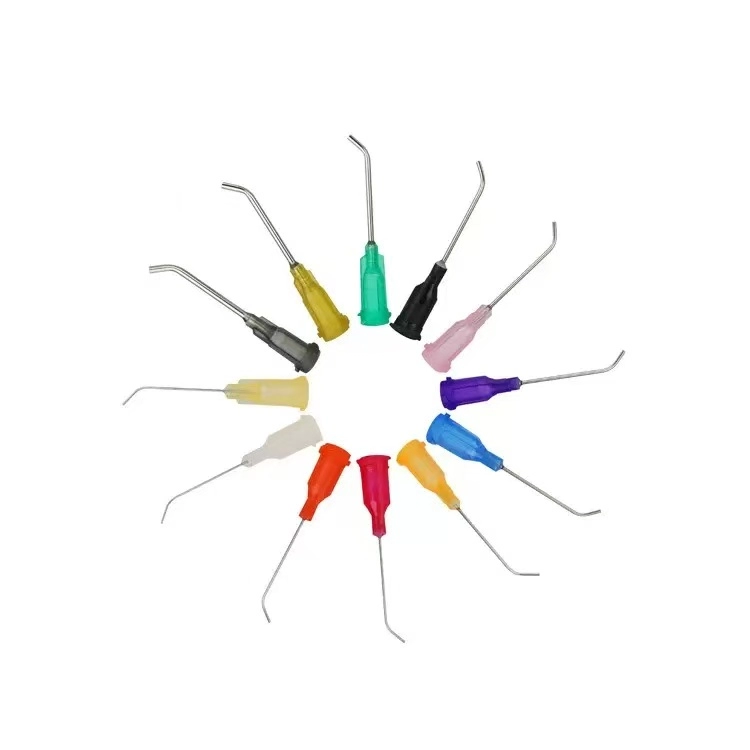
Different needle families redistribute the same seven parameters. Insulin pen needles add a sealing strip, needle seat, small sheath and large sheath to the assembly, are used for subcutaneous insulin injection, and must match the pen interfaces used in each market, with biological evaluation and insulin-solution compatibility testing completed as part of the product file. Dental irrigation needles use a bent cannula so that the tip reaches where the operator needs it without obstructing the view of the site. Dispensing needles for automated equipment are specified the opposite way round from clinical needles: the priority is a smooth, sharp bevel that stays unblocked after repeated punctures, a hub aperture that bonds firmly to the cannula, and dimensional consistency that lets the needle work with the customer's existing dispensing machine.
Whatever the family, the same brief applies: fix the application first, then the seven parameters, then the packaging. The packaging and sterilization requirements that follow from the specification are covered separately in our guide to private-label packaging, labeling and documentation.
A Short Checklist Before You Ask for a Quote
Send the application and the injection route, the gauge or the target outer diameter, the wall required if flow rate is critical, the length, the takeoff angle and bevel type if these are already defined, the connector type and the device the needle has to fit, the hub specification including whether color coding and a safety shell are required, the material declaration needed for your market, and the packaging and sterilization format. Include your target annual volume and your launch quantity, because both affect tooling and unit price more than any other input. Buyers who confirm a needle against the criteria for evaluating a needle tube manufacturer before quoting generally reach a stable specification faster, and the broader supplier assessment questions are set out in our guide to what makes a good needle and needle tube supplier.
Working With Us
Wenzhou Taiyu Medical Technology Co., Ltd. manufactures injection needles, insulin pen needles, infusion needles, cosmetic needles and needle sets, together with stainless steel capillary tubes and strips in 304 and 316L with custom outer and inner diameters, at a 10,000 square meter facility with over 220 employees. Production runs in a Class 100,000 cleanroom on automated lines with CCD vision inspection under a quality system certified to ISO 13485 and TUV CE. Our R&D and custom design team provides OEM/ODM collaboration, CNC sampling for capillaries and needle bevels, and regulatory guidance at design stage. Send us your drawing, specification or reference sample and we will confirm feasibility, tooling and lead time. The needle families we produce are grouped under injection and medication preparation, and general commercial terms are answered on our FAQ page.